Every December, an elf named Stella appears in my house.
For years, I did the typical Elf on the Shelf stuff. I would set up a little scene after my daughter went to bed, and she would find it the next morning. The elf might be sitting somewhere strange or surrounded by some kind of miniature Christmas mischief. Over time, the scenes became more elaborate. Then they became stories. Eventually there were letters, maps, puzzles, comics, software, and month-long games.
The problem with making a Christmas tradition more elaborate every year is that December is a busy month. AI became useful because it gave me more production capacity. I could develop a story, crank out daily material, create artwork, generate clues, and even build software while keeping the amount of work required each night reasonable. That has let a family tradition become far more ambitious than anything I could have done manually.
Before AI
As she got older, I wanted to make Stella more interactive. One early story involved an alien invasion. I made tiny monsters from pipe cleaners and pom-poms and taped a black construction-paper hole to the ceiling. The creatures descended from it on a string and gradually caused trouble around the house. It was silly, homemade, and required a large amount of preparation.
Then I started looking for ways to reduce the nightly workload. One solution was a wooden wand from Hobby Lobby that I painted red and white like a candy cane. During the week, my daughter completed small tasks like, touching the Christmas tree, that supposedly charged the wand with Christmas magic. On Friday night, she left it in a designated place. The next morning, that magic had produced a new elf scene. This gave me a perfectly reasonable explanation for doing one hard setup a week instead of every night.

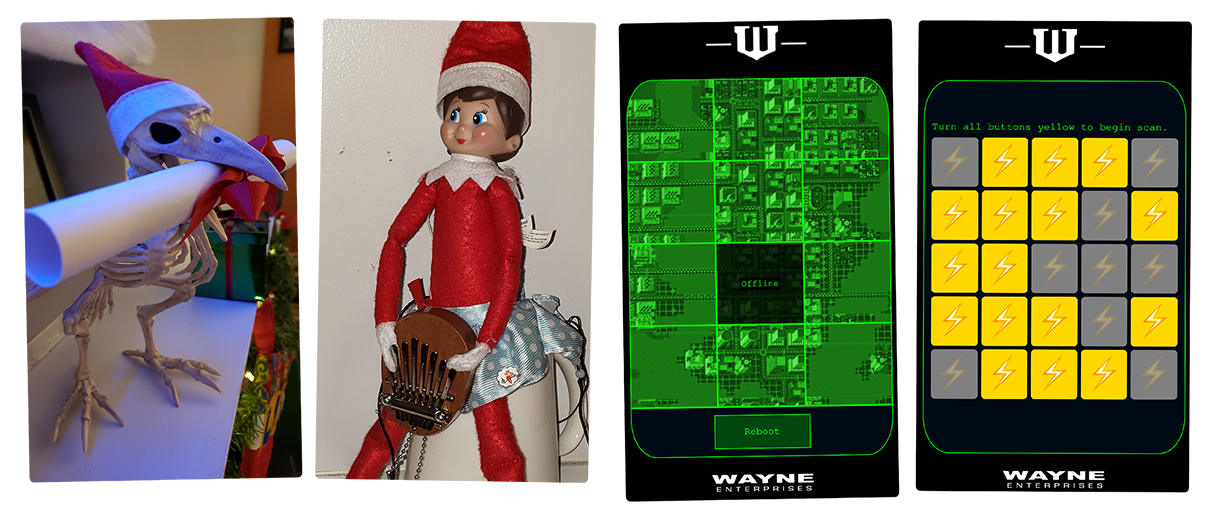
I was about to retire the Elf entirely, but the next year I brought it back as something closer to a lightweight role-playing game. In the first version, the elf had been captured in a spooky castle. A Halloween skeleton bird appeared on the mantel wearing the elf’s hat, carrying a letter in its beak. The letter described the present situation and my daughter wrote instructions telling the elf what to do next. I read her response and continued the story from there.
This brought new life into the whole thing. Now I could skip the crafty part and build out a written story. All I needed was to type out a letter every night. The exact chronology of some of these early games is fuzzy now. One year I designed a musical game around a kalimba. Each day she received a trivia clue whose answer corresponded to a musical note that culminated to a Christmas song.
It also allowed me to design the game before December, so I could have more time to set things up. Eventually, I moved the game into my wheelhouse as a software engineer. My daughter was into the recent Batman movie with the Riddler. I created a progressive web app designed as an official Wayne Tech corporate application. The Riddler had hacked Wayne Tech and was trying to take control of Gotham. Each day she answered a riddle. Correct answers removed Riddler question marks from a Gotham map I had adapted from a SimCity screenshot. Once the game started, it just ran by itself.
Giving the Elf a Voice
I spent much of 2023 experimenting with ChatGPT, AI-generated artwork, APIs, and my own AI comic generator. I realized that AI would be perfect for the main mechanic of our elf games, writing letters. Before AI, the letters were short and to the point. With GPT, I could establish an in-depth voice for the elf. I collected personality traits, previous examples, and rules for how Stella should speak. I keep those instructions in a dedicated ChatGPT project. When I need a new letter, I provide the current state of the story and out comes the next letter.
2023: Chasing Grimace Around the World
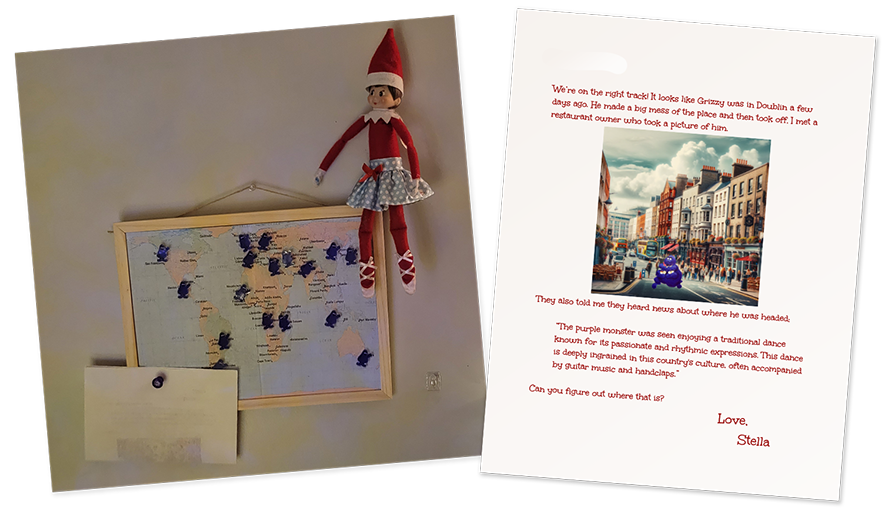
The 2023 game was inspired by Where in the World Is Carmen Sandiego? This year the elf traveled to McDonald Land. Grimace drank an experimental milkshake at the McDonald’s laboratory and reverted to his original, six armed, villainous form. The elf needed to chase him around the world and deliver an antidote.
I mounted a world map on a corkboard. Every day, Stella’s letter described where she had traveled and included an interview with someone from that location. Something the person said contained a clue pointing toward Grimace’s next destination. My daughter placed a pin in the country where she thought he would go.
With GPT writing elaborate letters with interviews in different voices, that made the game feel responsive. AI image generation allowed me to include an image of that day’s location. I added a cartoon Grimace to the image in Photoshop. As a finishing touch, I had custom Grimace pins made from StickerMule. They marked his path around the map, and the game ended with a Christmas Grimace Funko Pop as the prize.
This was the first year when AI materially changed the scale of what I could produce. The game had an international route, daily clues, individualized letters, and unique artwork for each location.
2024: Evil Meatwad Conquers America
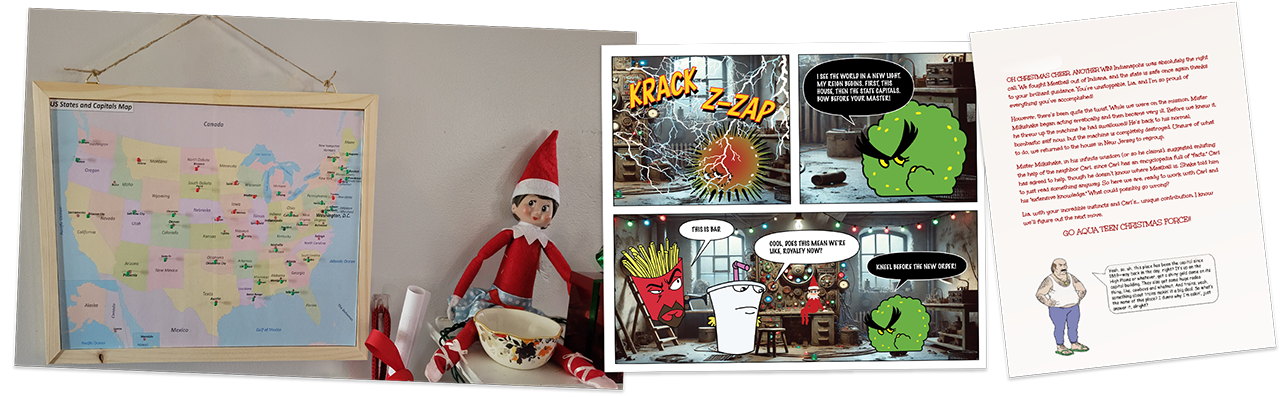
The next year, I built the game around her favorite show Aqua Teen Hunger Force. I was at a loss for the game premise and format, so I started with a real-time conversation with GPT and used it as a brainstorming partner. We worked through possible formats and eventually arrived at the premise that Frylock had built a machine, Master Shake interfered with it, and a malfunction transformed Meatwad into an evil version of himself. Evil Meatwad then set out to conquer the United States one state capital at a time.
The corkboard map was the United States, and my daughter had to determine where Meatwad was going next. This time, the clues came from characters on the show. At the bottom of each letter I placed clip art of the character providing that day’s clue. GPT was great in writing the clue in that character’s voice. Master Shake could be insulting and self-important. Carl wanted as little involvement as possible. Frylock behaved like the only responsible person in the room.
The game also included a short comic strip at the beginning and end of the month. Just like the Zeta Comic Generator, I generated backgrounds with AI. Then I composed the show’s characters and the elf into the scenes, along with dialog balloons. Creating a comic every night would have been too much work, even with AI.
2025: A Star Wars Scavenger Hunt
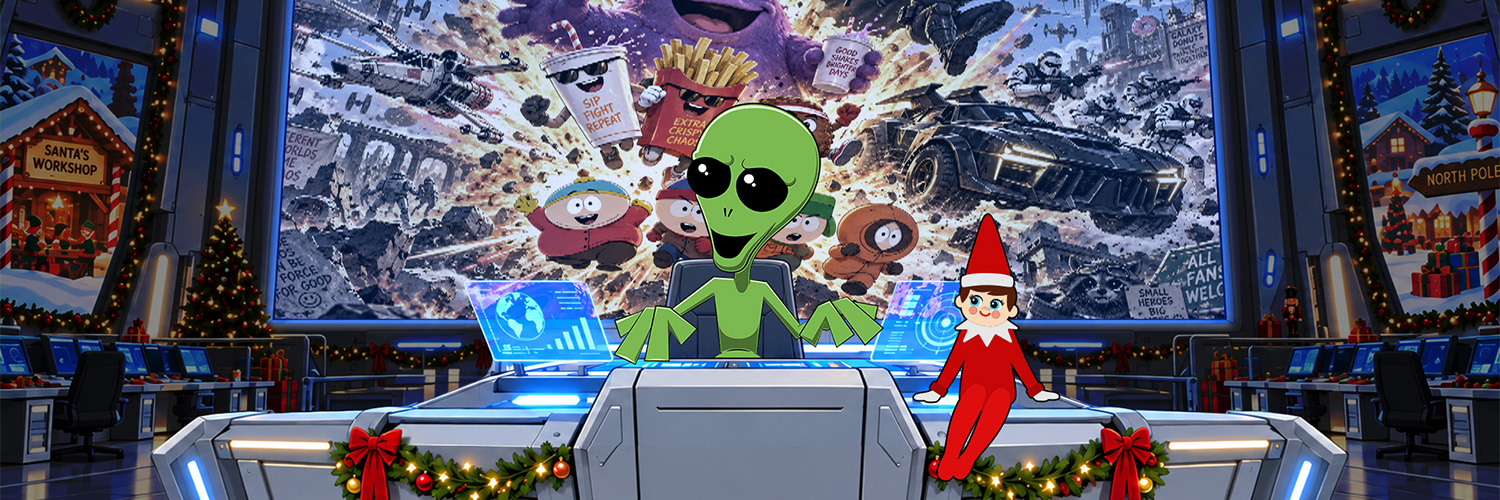
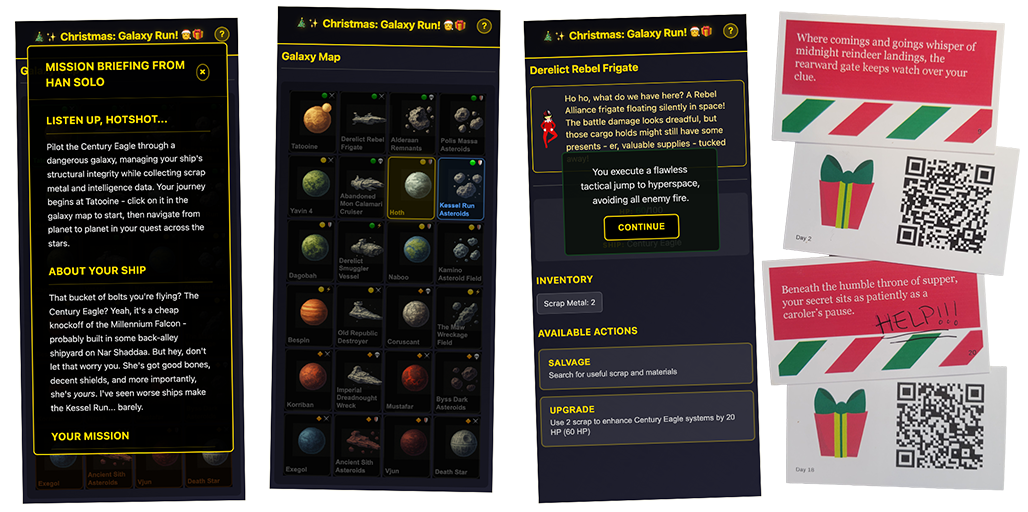
For 2025, I revisited my Batman app idea. I wanted almost everything finished before December began. The theme was Star Wars. The elf had joined the Rebel Alliance, which had discovered a new third Death Star. In keeping with Imperial engineering tradition, it contained another catastrophic design flaw. The rebels needed to collect enough intelligence to discover it.
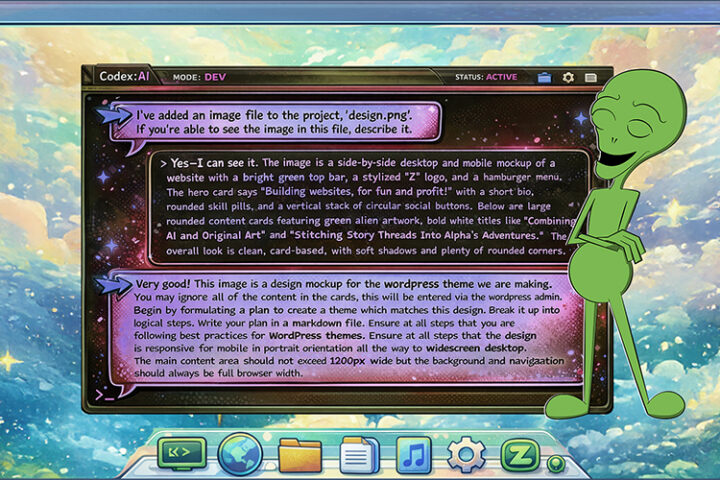
In a single weekend, I built a small progressive web app with Claude Code. The interface resembled an old menu-driven role-playing game adapted for a touchscreen. Each day, my daughter could play about thirty seconds of the larger adventure. I wanted to avoid ordinary trivia because I realized she was just looking up the answers. The physical portion of the game became a scavenger hunt. I printed 23 QR codes on business cards and hid them in locations around the house. Stella provided a separate clue card each day pointing toward one of those hiding places. A clue about a specific location inside our house couldn’t be found with a Google search. I had GPT describe ordinary locations in the most obscure way possible. For example, for the card hidden in the subwoofer wind tunnel, the clue was: “In the cavern where bass notes thunder like sleigh bells on steroids, your clue reverberates.”
When she found the hidden QR card and scanned it, the app unlocked the next part of the RPG. Her ship, the Century Eagle, traveled to another planet. There might be a short battle. Victories could provide intelligence, repairs, or upgrades. The daily interaction was intentionally brief because the scavenger hunt itself was part of the game. Claude Code handled all of the software. GPT helped with the story, the clues, and the elf’s daily letters. It also wrote an introductory letter in Han Solo’s voice.
2026: Refining the Formula
This year’s game is already developed, but I am keeping the theme secret for now. My daughter will be in college next year so this will probably be my last one. I went back to a physical map. This time, I enlarged it onto a foam board. It’s nearly five feet wide. My daughter will direct the elf to different locations as the story progresses, and GPT rendered images printed on business cards will be added to the board. There will also be an introductory comic created using a process similar to the Aqua Teen Hunger Force game. This year is more focused on story than game mechanics.
GPT also played a larger role in planning this year’s story because I do not know the source material as deeply as some of the properties I have used before. A real-time conversation helped me work through the premise, characters, locations, and overall structure. Once December begins, the same system I have used for the past several years will take over. I will provide the current state of the story, include anything my daughter did that needs to be acknowledged, and generate Stella’s next letter.
The Part AI Changed
Looking back at these games, I can see a progression in how AI has grown in capability. At first, GPT solved a writing problem. It gave the elf a consistent voice and made daily letters easy to produce. Then it became useful for game design. It could help develop routes, clues, story treatments, and character dialogue. Image generation expanded what I could put on the page. Coding agents let me build small pieces of custom software without turning an Advent project into a second job.
The biggest benefit is that these capabilities automate a mountain of work. A project like the Star Wars game required a story, household clues, printed QR cards, a web application, game text, and daily letters. The current project adds a huge physical map, custom character art, comics, and a story that can react to decisions made during the month. They represent a lot of production. GPT is literally doing the work that would require a team of 5-10 designers, developers and writers. It lets me do a job, by myself, that would have otherwise been impossible.
The best part is that I still get to do the parts that are fun. I choose the theme, develop the game and do all the creative work. That is why these projects have become one of my favorite uses for AI. It lets me do the kinds of creative projects I love to do, at a scale I couldn’t possibly do. They combine software development with writing, illustration, game design, and a fair amount of paper and printer ink. Without AI, I would still do something every year. But it would be much simpler. With AI, I can take the ridiculous idea that occurs to me and actually build it, while still having a December outside of the project.
After all these years, AI may be the most useful Christmas magic I have found.